

January 12, 2026
PPC & Google Ads Strategies
Google Ads for Industrial Equipment Dealers: Negative Keywords That Separate Million-Dollar Contracts From Spare Parts Seekers
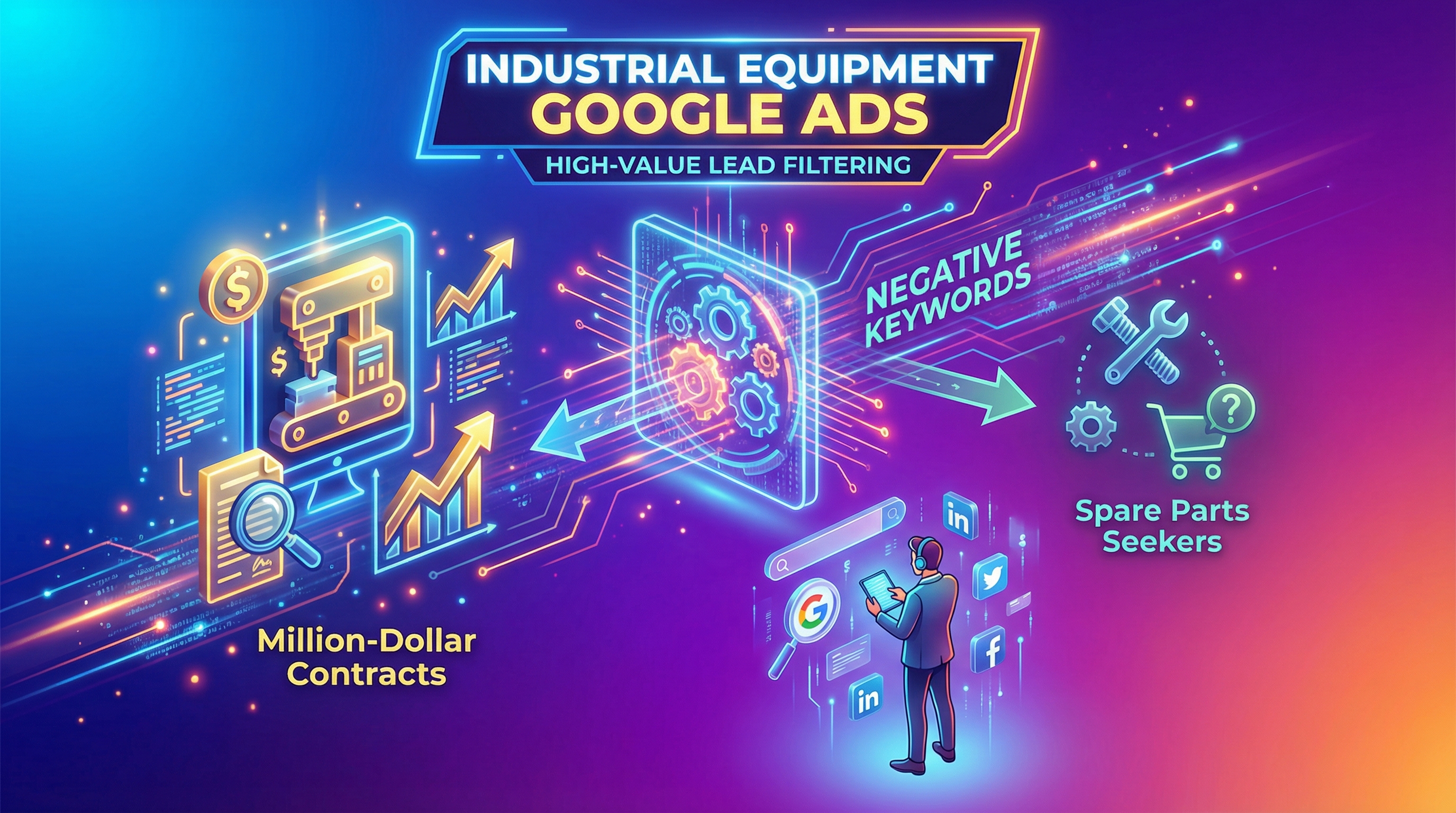
The industrial equipment market represents a $331 billion opportunity, but most search traffic has no intention of purchasing million-dollar machinery. This comprehensive guide shows dealers exactly how to use negative keywords to separate high-value buyers from spare parts seekers, job hunters, and hobbyists.
The $331 Billion Industrial Equipment Market Has a Search Intent Problem
The industrial equipment market in the United States alone is projected to reach $331.7 billion by the end of 2025, growing at a steady 2.7% annually. For dealers of heavy machinery, construction equipment, manufacturing systems, and industrial tools, this represents enormous opportunity. But there's a challenge that costs industrial equipment dealers thousands of dollars daily: most search traffic has no intention of purchasing million-dollar machinery.
Your Google Ads campaigns attract two fundamentally different audiences. On one hand, you have procurement managers, plant engineers, and C-suite executives researching capital equipment purchases worth six or seven figures. These buyers have budget authority, specific operational requirements, and a 6-18 month sales cycle ahead of them. On the other hand, you have maintenance technicians looking for replacement gaskets, students researching for school projects, job seekers wanting to operate equipment, DIY enthusiasts browsing for small parts, and countless other low-intent searchers who will never become customers.
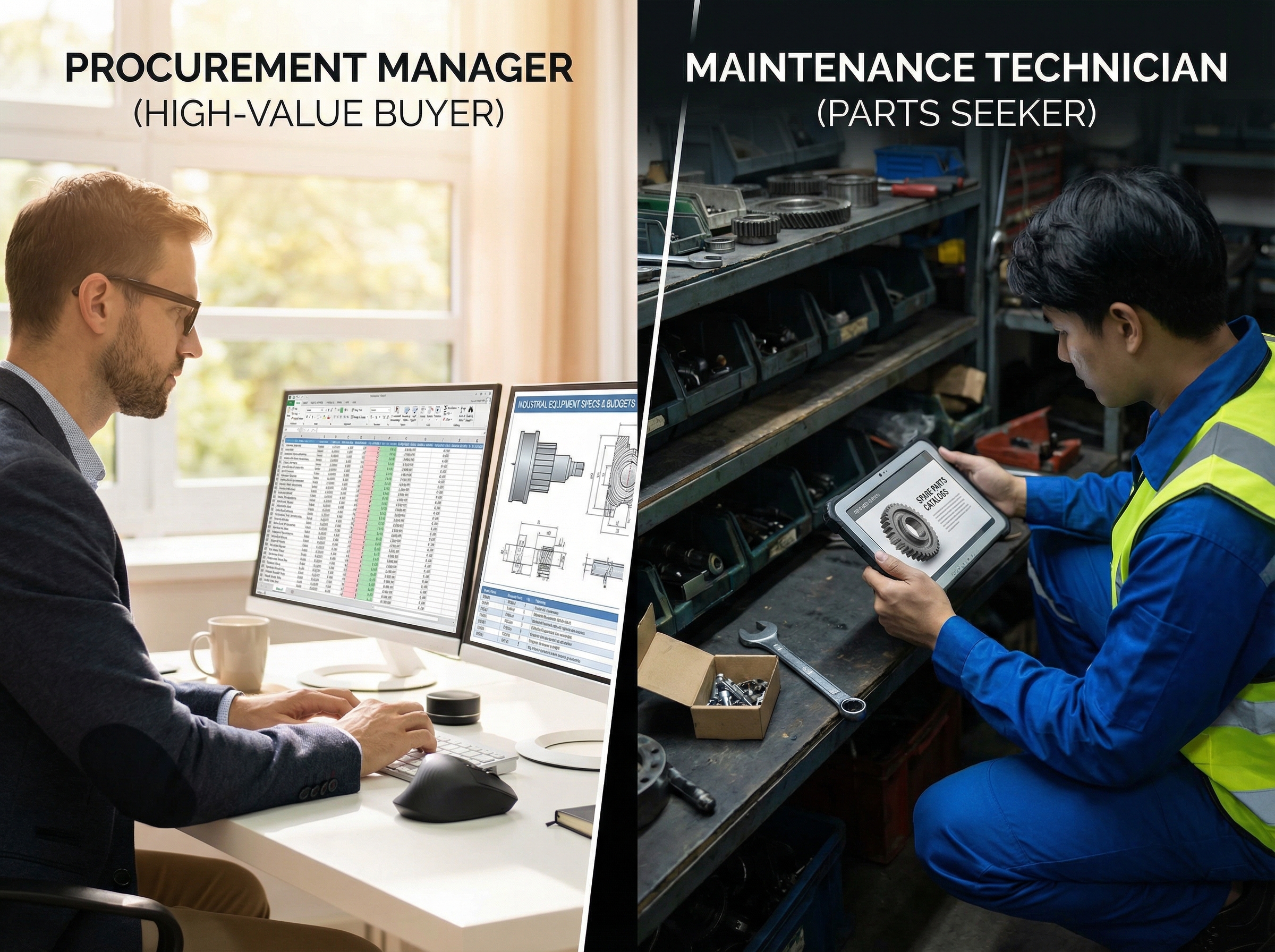
The difference between these audiences is the difference between a $2 million excavator sale and a $40 air filter. Yet without strategic negative keyword implementation, your campaigns treat them identically, burning through budget on clicks that have zero chance of generating revenue. This article shows you exactly how to separate high-value industrial buyers from spare parts seekers, protecting your advertising investment while focusing exclusively on prospects who can actually sign contracts.
Why Industrial Equipment Advertising Requires a Different Negative Keyword Strategy
Industrial equipment sales operate in a completely different universe than consumer products or even typical B2B services. According to research from Directive Consulting, complex B2B industries like industrial equipment show appointment booking rates around 8%, compared to 27% for simpler service-based sectors. This disparity reflects longer sales cycles, multiple decision-makers, and significantly higher stakes.
The path from initial search to signed contract in industrial equipment can span 12-24 months. During this time, multiple stakeholders research specifications, compare vendors, evaluate financing options, and coordinate with operations teams. Your Google Ads campaigns must account for this extended journey while filtering out searchers who will never enter it. The challenge is that both high-intent buyers and low-intent browsers use similar search terms, making basic keyword targeting insufficient.
Consider the economics. A single excavator, CNC machine, or industrial press can generate $50,000 to $5,000,000 in revenue with profit margins between 15-30%. Customer lifetime value for industrial equipment buyers who return for additional purchases, upgrades, and service contracts can easily exceed $10 million. Contrast this with the $12-150 value of parts, accessories, or rental inquiries. Your customer lifetime value math makes it economically rational to spend $500 per click if it reaches the right buyer, while simultaneously making it wasteful to spend $2 per click on wrong-fit traffic.
Industrial equipment buyers display distinct search behavior patterns. They use highly specific technical terminology, research multiple specifications simultaneously, compare brands extensively, and often search during business hours. According to RevNew's research on manufacturing buyer intent signals, engineers and procurement professionals searching for industrial equipment show clear intent indicators: they review specific product pages, read technical blogs about features and benefits, search for supplier comparisons, and engage with detailed specification documents. Your negative keyword strategy must preserve these high-value behaviors while excluding everyone else.
The Anatomy of a Low-Intent Industrial Equipment Search
Spare parts seekers represent the largest category of low-intent traffic for industrial equipment dealers. These searches come from maintenance technicians, facility managers, and equipment operators who need replacement components, consumables, or accessories for existing machinery. While parts sales can be profitable, they require entirely different sales processes, pricing structures, and fulfillment systems than equipment sales. More importantly, they consume advertising budget that should target new equipment buyers.
Parts-related searches follow predictable patterns. Look for terms including "replacement," "spare," "parts," "components," "accessories," "consumables," "filters," "belts," "gaskets," "seals," "bearings," and specific part numbers. Searchers often add size specifications, model numbers, or OEM references. For example, someone searching "hydraulic pump parts for CAT 320" has zero interest in purchasing a new excavator. They need a specific component for existing equipment. Your negative keyword list should systematically exclude these variations.
DIY enthusiasts and hobbyists represent another major source of wasted spend. These searchers want industrial-style equipment for personal projects, home workshops, or small-scale operations at price points incompatible with commercial-grade machinery. They search for terms like "home workshop," "garage," "DIY," "personal use," "hobby," "small scale," "mini," "portable," "lightweight," and "budget." Someone searching "mini CNC machine for home workshop" will never become a customer for commercial machining equipment. Exclude these terms aggressively.
Job seekers searching for equipment operation positions generate substantial irrelevant traffic. These searches include "jobs," "careers," "hiring," "operator positions," "training," "certification," "how to operate," "salary," and "employment." While these individuals may be excellent employees, they're not equipment buyers. Similarly, exclude educational searches from students researching for academic projects using terms like "research paper," "school project," "study," "thesis," "assignment," and "how does [equipment] work."
Rental inquiries deserve special attention because the intent appears similar to purchase intent, but the economics differ dramatically. Someone searching "excavator rental daily rate" or "rent industrial forklift" wants short-term access, not ownership. Unless your dealership offers rental services as a strategic lead generation tool, exclude rental-related terms. However, if you do offer rentals that can lead to purchases, you may want to segment rental campaigns separately with different budgeting and conversion tracking. Learn more about handling this distinction in our guide on negative keywords for equipment rental companies.
High-Value Buyer Signals You Must Protect
While building your negative keyword list, you must simultaneously protect high-value buyer signals from accidental exclusion. Industrial equipment buyers use specific terminology that indicates genuine purchase intent, significant budget authority, and active procurement processes. These search patterns represent the exact traffic your campaigns should prioritize, and over-aggressive negative keyword application can block them. Understanding what to protect is just as critical as knowing what to exclude.
Procurement-specific language signals serious buying intent. Terms like "procurement," "sourcing," "RFP," "RFQ," "quote," "proposal," "bid," "capital equipment," "capex," "fleet," "bulk," and "enterprise" indicate organizational purchasing processes. When someone searches "construction equipment procurement process" or "industrial press RFP specifications," they're deep in the buying cycle with budget allocated. Never add these terms as negative keywords. Similarly, phrases indicating specification research like "load capacity," "tonnage," "throughput," "cycle time," "specifications," and technical model numbers represent serious buyer research.
Comparison shopping between commercial brands indicates active evaluation by qualified buyers. Searches like "CAT vs Komatsu excavator comparison" or "best CNC machine for manufacturing facility" show buyers narrowing their shortlist. These searchers have moved past awareness into consideration and evaluation. Comparison terms including "vs," "versus," "comparison," "best for," "top rated," "leading," and brand name combinations should never appear in your negative keyword list. This is the traffic that converts to qualified sales conversations.
Financing and budgeting terms signal purchase readiness with allocated capital. Searches including "financing options," "lease," "monthly payment," "tax benefits," "depreciation," "ROI calculator," and "total cost of ownership" come from buyers who have moved past the question of whether to purchase and are now determining how to structure the transaction. These are high-quality leads actively preparing to buy. Protect these terms rigorously.
The distinction between browsing and buying searches becomes especially critical in industrial equipment advertising. Our analysis of search intent differentiation shows that buyer language focuses on outcomes, specifications, and business impact, while browser language emphasizes learning, understanding, and general exploration. Searches like "how excavators work" indicate browsing, while "excavator load capacity for highway construction" indicates buying. Your negative keyword strategy must preserve the latter while filtering the former.
The Core Negative Keyword Framework for Industrial Equipment Dealers
Building an effective negative keyword framework for industrial equipment requires systematic categorization of low-value search patterns. This framework organizes negative keywords into strategic categories that align with how searchers actually behave, making your lists easier to maintain, update, and optimize over time. Rather than creating ad hoc negative keyword lists, this structured approach ensures comprehensive coverage while minimizing the risk of accidentally blocking valuable traffic.

Category 1: Parts, Accessories, and Consumables
This category excludes searchers looking for replacement parts, components, accessories, or consumables rather than complete equipment. Add these negative keywords at the campaign or account level depending on whether you have separate campaigns for parts sales. Core terms include: "parts," "spare parts," "replacement parts," "components," "accessories," "add-ons," "attachments," "consumables," "supplies," "filters," "belts," "gaskets," "seals," "bearings," "hoses," "valves," "fittings," "connectors," "cables," "wiring," "switches," "sensors," "part number," "OEM parts," "aftermarket parts," "compatible with," "fits," and "for [specific model number]." Expand this list with equipment-specific components relevant to your inventory.
Category 2: Rental, Used, and Alternative Acquisition Methods
These terms filter searchers who want temporary access or significantly lower price points than new equipment. Unless your business model specifically targets these segments, exclude: "rent," "rental," "lease," "hire," "borrow," "used," "pre-owned," "secondhand," "refurbished," "reconditioned," "salvage," "auction," "liquidation," "clearance," "discount," "cheap," "affordable," "budget," "low cost," "inexpensive," "free," "donation," and "giveaway." Consider whether your dealership sells certified pre-owned equipment, in which case you might segment used equipment into separate campaigns rather than blocking entirely.
Category 3: DIY, Consumer, and Small-Scale Operations
This category excludes searchers seeking equipment unsuitable for commercial industrial applications. Add: "DIY," "do it yourself," "home," "homeowner," "residential," "personal," "hobby," "hobbyist," "garage," "workshop," "small scale," "mini," "compact," "portable," "lightweight," "handheld," "manual," "toy," "model," "miniature," "for kids," and "beginner." These terms indicate searchers want consumer-grade equipment at consumer price points incompatible with industrial machinery.
Category 4: Informational and Educational Searches
Filter searchers seeking knowledge rather than making purchases. Include: "what is," "how does," "how to," "definition," "meaning," "explained," "guide," "tutorial," "course," "training," "certification," "study," "research," "thesis," "paper," "project," "assignment," "history," "inventor," "Wikipedia," "images," "pictures," "videos," "diagram," and "blueprint." While some informational searches may represent early-stage research by serious buyers, the majority come from students, educators, or casual browsers.
Category 5: Employment and Career Searches
Exclude job seekers who will never purchase equipment. Add: "jobs," "careers," "employment," "hiring," "positions," "openings," "apply," "resume," "salary," "wage," "operator job," "technician position," "mechanic hiring," "training program," and "apprenticeship." These searches come from individuals seeking to work with equipment, not buy it.
Category 6: Repair, Service, and Maintenance
Filter searchers needing maintenance services rather than new equipment. Unless you offer these services, exclude: "repair," "fix," "broken," "troubleshooting," "maintenance," "service," "servicing," "inspection," "diagnostic," "not working," "won't start," "error code," "problem with," "issue," and "malfunction." These indicate existing equipment problems, not new purchase intent.
Match Type Strategy for Industrial Equipment Campaigns
Understanding how negative keyword match types work in Google Ads is critical for industrial equipment dealers. According to Google's official documentation, negative keywords function differently than positive keywords, and these differences significantly impact how effectively you filter traffic. Choosing the wrong match type can either allow low-intent traffic through or accidentally block high-value buyers.
Negative broad match blocks searches containing all negative keyword terms in any order, but may show your ad if the search contains only some of the terms. For example, adding "repair" as negative broad match would block "excavator repair services" and "repair industrial equipment," but might not block "repairing excavators" due to word variation. Negative broad match provides the widest blocking but requires careful management to avoid gaps. Use broad match negatives for clearly irrelevant terms like "toy," "game," "cartoon," or "Halloween costume" where any appearance indicates zero buyer intent.
Negative phrase match blocks searches containing the exact phrase in the same order, but allows additional words before or after. Adding "spare parts" as negative phrase match blocks "industrial equipment spare parts" and "excavator spare parts catalog," but allows "parts and accessories" or "spare excavator." Phrase match provides moderate blocking with better control. Use phrase match negatives for multi-word combinations like "how to," "for kids," "repair service," or "rental rates" where word order matters to intent.
Negative exact match blocks only searches matching the exact term with no additional words. Adding [repair] as negative exact match blocks only the single word "repair" but allows "excavator repair," "repair service," or "repairs." Exact match provides the most precise blocking with highest risk of allowing variations through. Use exact match negatives sparingly, primarily for single words you want to block only in isolation, though this scenario rarely applies in industrial equipment advertising.
For industrial equipment campaigns, we recommend a layered approach. Start with phrase match negatives for your core exclusion categories, as these provide effective blocking while maintaining control. Add broad match negatives for obviously irrelevant terms that should never trigger ads. Review search term reports weekly during the first month, then bi-weekly, adding new phrase match negatives as patterns emerge. This balanced strategy maximizes traffic filtering while minimizing the risk of blocking qualified buyers.
Industry-Specific Negative Keywords by Equipment Category
Different types of industrial equipment attract distinct low-intent search patterns requiring specialized negative keyword strategies. While the core framework applies across all equipment categories, successful dealers develop additional negative keyword sets tailored to their specific inventory. These industry-specific terms account for the unique ways searchers interact with different equipment types, ensuring more precise traffic filtering.
Construction and Earthmoving Equipment
Dealers selling excavators, bulldozers, backhoes, loaders, and graders face high volumes of searches from equipment operators, construction workers seeking jobs, and video game enthusiasts. Add industry-specific negative keywords including: "simulator," "game," "video game," "controls," "how to operate," "operator training," "certification course," "practice," "virtual," "sandbox," "sandbox game," "operator salary," "operator jobs," "CDL," "licensing," "stick control," and "joystick." Construction equipment generates significant search volume from entertainment-related queries that waste budget.
Manufacturing and Machining Equipment
Dealers selling CNC machines, lathes, mills, presses, and industrial fabrication equipment attract searches from students, hobbyists, and makers. Exclude: "desktop," "benchtop," "hobby," "home shop," "garage shop," "maker space," "art project," "jewelry making," "craft," "3D printer alternative," "beginner machine," "learning," "educational," "school shop," "makerspace," and specific consumer brands like "Sherline" or "Taig" that indicate hobby-level interest. Manufacturing equipment searches often blur the line between professional and consumer intent, requiring careful filtering.
Material Handling and Warehouse Equipment
Dealers selling forklifts, pallet jacks, conveyors, and warehouse systems see searches from warehouse workers, logistics professionals seeking employment, and small business owners needing consumer-grade solutions. Add: "manual," "hand operated," "small warehouse," "home business," "garage storage," "warehouse job," "forklift certification," "training course," "license," "operator position," "warehouse hiring," "logistics jobs," and "shipping clerk." Material handling equipment generates particularly high employment-related search volume.
Agricultural and Farming Equipment
Dealers selling tractors, combines, harvesters, and irrigation systems attract searches from hobby farmers, rural property owners, and agricultural students. Exclude: "hobby farm," "small farm," "homestead," "acreage," "rural property," "lawn," "yard," "garden," "landscaping," "residential," "compact," "sub-compact," "small acreage," "few acres," and "farming games." Agricultural equipment requires careful distinction between commercial farming operations and lifestyle farmers with different buying power and equipment needs.
The Critical B2B vs. Consumer Search Pattern Distinction
Industrial equipment sales operate exclusively in the B2B space, but Google search doesn't automatically distinguish between business and consumer searchers. According to our research on B2B versus B2C negative keyword strategies, the linguistic patterns between these audiences differ dramatically. Understanding and filtering consumer patterns is essential for industrial equipment dealers who cannot serve consumer buyers under any circumstances.
Consumer searchers use first-person language, emotional terms, and value-focused phrases. They search for "I need," "help me," "best for me," "affordable," "deal," "discount," "sale," and "clearance." Business searchers use organizational language, technical specifications, and ROI-focused terms. They search for "enterprise," "fleet," "commercial," "industrial," "specifications," "capacity," "productivity," and "ROI." Your negative keyword list should systematically exclude first-person and emotional consumer language while preserving business-focused terminology.
Consumer searches emphasize immediate availability and instant gratification using terms like "same day," "near me," "open now," "in stock," "quick delivery," and "buy now." Business searches acknowledge longer timelines with terms like "Q4 purchase," "2026 budget," "project planning," "implementation timeline," and "delivery schedule." While you should certainly highlight in-stock inventory, exclude negative keywords suggesting unrealistic consumer expectations like "overnight delivery," "next day," or "same day pickup" that don't align with industrial equipment logistics.
Consumer searches reflect individual decision-making using terms like "should I," "is it worth," "do I need," and "reviews from users." Business searches reflect committee decisions using terms like "vendor evaluation," "stakeholder approval," "procurement process," "competitive bidding," and "executive approval." Exclude consumer decision language that indicates solo buyers without organizational purchasing authority or processes.
Why Protected Keywords Matter in Industrial Equipment Campaigns
As you build comprehensive negative keyword lists, the risk of accidentally excluding valuable traffic increases. Industrial equipment terminology often contains words that, in isolation, seem negative but within specific contexts indicate strong buying intent. This is where protected keywords become essential. The protected keywords feature prevents accidentally blocking high-value search terms that coincidentally contain words also appearing in negative keyword lists.
Consider the phrase "replacement equipment." The word "replacement" typically indicates parts seekers, so you might add "replacement" as a negative keyword. However, "replacement equipment" indicates a buyer seeking to replace an entire aging unit with new machinery, representing exactly the high-value prospect you want. Similarly, "lease" might be added as a negative keyword to exclude rental searchers, but "capital equipment lease financing" represents a qualified buyer evaluating acquisition methods. These collisions waste valuable opportunities.
Negator's protected keywords feature solves this problem by allowing you to designate specific phrases that should never be excluded regardless of negative keyword lists. When you add "replacement equipment," "equipment replacement," "lease financing," "equipment lease," and "capital lease" as protected keywords, the system ensures these phrases trigger ads even though they contain words in your negative keyword list. This provides the precision needed for industrial equipment campaigns where context completely changes intent.
Build your protected keywords list by reviewing your highest-performing search terms from the past 90 days. Identify any terms containing words that also appear in your negative keyword lists. Add these complete phrases as protected keywords before expanding your negative keyword strategy. Update your protected keywords monthly as you discover new high-value terms that contain potentially negative words. This proactive approach prevents revenue loss from over-aggressive filtering.
Geographic and Language Considerations for International Equipment Dealers
Industrial equipment dealers serving multiple markets face additional complexity in negative keyword management due to regional terminology differences, language variations, and cultural factors affecting search behavior. What indicates low intent in one market may signal high value in another, requiring market-specific negative keyword strategies rather than universal lists.
Industrial equipment terminology varies significantly across English-speaking regions. British searchers use "plant hire" where Americans search "equipment rental," "lorry" instead of "truck," and "digger" instead of "excavator." Australian searchers use "earthmoving plant" and "machinery hire" with distinct patterns. If you serve multiple English-speaking markets, segment campaigns geographically and tailor negative keywords to regional language patterns. What blocks low-intent traffic in one market may exclude high-value buyers in another.
For dealers serving non-English markets, direct translation of negative keywords often fails because search intent patterns differ culturally. Some languages use longer phrases for the same concepts, changing how match types function. Slang and colloquialisms vary dramatically. Work with native speakers in each target market to develop culturally appropriate negative keyword lists rather than relying on automated translation. This investment pays dividends in traffic quality improvement.
Geographic markets use different terminology around pricing, financing, and value. American searchers use "cheap," British searchers say "cheap as chips," and Australian searchers use "good price." These variations require market-specific negative keyword lists for value-focused consumer language. Similarly, financing terms vary: "hire purchase" in the UK, "financing" in the US, and "leasing" with different connotations across markets. Understand local business terminology before implementing negative keyword filters.
The AI-Powered Approach to Industrial Equipment Negative Keywords
Manual negative keyword management for industrial equipment campaigns becomes unsustainable at scale. Dealers managing multiple product lines, geographic markets, and campaign structures face hundreds of search terms daily requiring classification decisions. Traditional rule-based approaches catch obvious patterns but miss nuanced intent signals, while manual review consumes hours that could be spent on strategic initiatives. AI-powered automation solves this challenge by analyzing search terms using business context to identify low-intent traffic with precision impossible manually.
Traditional negative keyword tools use simple pattern matching: if a search term contains "parts," block it. This approach fails for industrial equipment where context changes intent dramatically. "Parts diagram for assembly line" indicates general browsing, but "industrial press parts and complete systems" indicates a buyer evaluating both options. Context-aware AI analyzes the complete search phrase alongside your business profile, active keywords, and campaign structure to determine actual intent. This nuanced classification dramatically improves traffic quality.
Negator analyzes search terms by combining multiple signals: the complete search phrase, your business category and product offerings, your active keywords showing what you want to attract, your existing negative keywords showing what you want to avoid, and historical performance patterns from similar advertisers. This multi-factor analysis classifies search terms with accuracy matching experienced PPC managers while processing volume impossible manually. The system suggests negative keywords with explanations, maintaining human oversight while automating the heavy analytical work.
The time savings become substantial quickly. Manual search term review for an industrial equipment dealer with 10 product categories typically requires 3-5 hours weekly. An experienced PPC manager reviews 150-200 search terms per hour, classifying each as valuable traffic, potential negative keyword, or ambiguous requiring deeper investigation. AI automation processes this same volume in minutes, allowing you to review suggested negatives rather than analyzing raw search terms. This shifts your time from data processing to strategic decision-making about campaign structure and messaging.
Beyond time savings, AI-powered negative keyword management delivers measurable improvements in lead quality. Our analysis shows dealers implementing context-aware negative keyword automation see 25-40% improvement in lead qualification rates within 30 days. By filtering low-intent traffic more precisely, your campaigns attract more procurement managers, plant engineers, and executives with actual buying authority. This improved traffic quality flows through your entire sales funnel, increasing both conversion rates and average deal size. Learn more about this impact in our guide on how negative keywords improve lead quality.
Measuring Success: KPIs for Industrial Equipment Negative Keyword Performance
Implementing negative keywords without measuring their impact leaves you blind to whether your strategy actually works. Industrial equipment dealers need specific KPIs that connect negative keyword management to business outcomes. These metrics help you quantify savings, optimize continuously, and justify the time invested in negative keyword strategy.
Track monthly wasted spend prevented by negative keywords. Calculate this by identifying search terms you blocked, estimating their click volume based on impression data before exclusion, multiplying by your average CPC, and summing across all blocked terms. For example, if you blocked 50 search terms that were generating 200 clicks monthly at $12 average CPC, you prevented $2,400 in monthly waste or $28,800 annually. This metric quantifies the direct financial impact of your negative keyword strategy.
Monitor lead qualification rate changes over time. Track the percentage of form submissions or phone calls that meet your qualification criteria before and after implementing negative keyword improvements. Industrial equipment dealers typically see lead qualification rates improve from 15-25% to 35-50% as negative keywords filter low-intent traffic. This improvement reduces sales team time wasted on unqualified prospects while increasing focus on legitimate opportunities.
Measure campaign conversion rate trends as your negative keyword list matures. With better traffic quality, conversion rates should increase even if traffic volume decreases. A campaign generating 500 clicks with a 2% conversion rate produces 10 conversions. After negative keyword optimization, that same campaign might generate 350 clicks with a 4% conversion rate, producing 14 conversions with 30% less spend. This demonstrates efficient traffic quality improvement.
Calculate cost per qualified lead, not just cost per lead. Many industrial equipment campaigns generate high lead volumes at low CPL but discover most leads are unqualified. Track the cost to generate leads that actually meet your criteria: decision-maker contact, appropriate company size, relevant application, budget alignment, and purchase timeline. This metric matters more than any other because it directly connects advertising spend to sales opportunities.
Monitor whether negative keyword improvements affect sales cycle length and close rates. Higher quality traffic from better-qualified searchers should theoretically move through your sales process faster with higher conversion to closed deals. Track the percentage of qualified leads that become proposals, and the percentage of proposals that close. Improvements in these downstream metrics validate that your negative keyword strategy truly separates million-dollar contracts from parts seekers.
Ongoing Maintenance: Building a Sustainable Negative Keyword Process
Negative keyword management is not a one-time project but an ongoing process requiring consistent attention. Search behavior evolves, new product lines introduce new terminology, competitors change their strategies affecting what searchers see, and Google's algorithm updates alter how broad match keywords trigger. Sustainable negative keyword management requires establishing regular review processes that catch new patterns before they waste significant budget.
Implement a weekly search term review process, particularly during the first 60 days after launching campaigns or after significant keyword expansion. Review all search terms that generated more than three clicks, focusing on terms you haven't previously evaluated. Sort by cost to prioritize expensive terms first. Add new negative keywords immediately when patterns emerge. This regular cadence prevents low-intent terms from accumulating unnoticed cost.
Conduct deeper monthly analysis reviewing search terms with 1-2 clicks that might indicate emerging patterns. Look for common themes across multiple low-performing terms suggesting category-level negative keywords you haven't considered. Review your protected keywords list, removing any that no longer generate valuable traffic while adding new high-value terms. Analyze performance by match type, adjusting your negative keyword match type strategy based on results.
Quarterly strategic reviews assess whether your negative keyword strategy aligns with business changes. New product launches require new positive keywords and new negative keywords to filter related low-intent traffic. Market expansion into new industries or applications introduces new searcher types requiring evaluation. Seasonal factors in industrial equipment affect search patterns, with budget cycles, weather, and fiscal year planning creating predictable variations needing strategy adjustments.
Document your negative keyword strategy with clear reasoning for each major exclusion category. When team members understand why specific terms are blocked, they make better decisions about edge cases and new patterns. Create a shared knowledge base explaining your negative keyword philosophy, common scenarios requiring judgment calls, and approved processes for adding new negatives. This documentation ensures consistency across team members and preserves institutional knowledge as staff changes.
Implementing Your Industrial Equipment Negative Keyword Strategy
The difference between million-dollar contracts and spare parts seekers comes down to precision in who sees your ads. Industrial equipment dealers face unique advertising challenges: extremely high customer lifetime values, extended sales cycles, multiple stakeholders, and search traffic that overwhelmingly skews toward low-intent browsers, parts seekers, job hunters, and hobbyists. Without strategic negative keyword implementation, you waste budget on clicks that have zero possibility of generating revenue while competing for impression share against your actual target audience.
Start by implementing the core negative keyword framework covering parts and accessories, rental and used equipment, DIY and consumer searches, informational queries, employment searches, and repair services. Customize these categories with industry-specific terms relevant to your equipment types. Use phrase match as your default match type for balanced blocking with controlled precision. Establish protected keywords to prevent accidentally excluding high-value terms containing negative keyword components.
Build sustainable processes for ongoing management with weekly search term reviews, monthly performance analysis, and quarterly strategic assessments. Measure success through metrics that matter: wasted spend prevented, lead qualification rates, cost per qualified lead, and downstream sales metrics. These measurements demonstrate the business impact of your negative keyword strategy while identifying opportunities for continuous improvement.
Consider implementing AI-powered automation to scale your negative keyword management beyond what manual processes can achieve. Context-aware classification identifies nuanced intent patterns impossible to catch with rule-based systems, while processing volume that would require hours daily manually. This automation doesn't replace strategic oversight but amplifies your effectiveness, allowing you to focus on high-level strategy rather than repetitive data processing.
Every dollar saved on irrelevant clicks is a dollar available to reach the procurement managers, plant engineers, and executives who actually sign contracts for industrial equipment. Your negative keyword strategy directly determines whether your advertising investment focuses on million-dollar opportunities or dissipates across thousands of searchers who will never become customers. Implement these frameworks, measure the results, and refine continuously. The difference shows up in both your Google Ads account and your sales pipeline.
Google Ads for Industrial Equipment Dealers: Negative Keywords That Separate Million-Dollar Contracts From Spare Parts Seekers
Discover more about high-performance web design. Follow us on Twitter and Instagram

.webp)




Fresh trends & insights

[ Follow us ]
[ Join our newsletter ]