


January 28, 2026
PPC & Google Ads Strategies
Why Your Google Ads Account Recovers Slower Than Competitors: The Negative Keyword Technical Debt Slowing Your Pivot Speed
When market conditions change, your competitors pivot their Google Ads campaigns in days. You take weeks. The difference is not strategy, budget, or team size—it is negative keyword technical debt, the accumulated cost of inconsistent exclusion management that slows every major account decision you make.
The Hidden Metric That Determines Who Wins During Market Shifts
When market conditions change, your competitors pivot their Google Ads campaigns in days. You take weeks. When they launch new offers, their accounts respond cleanly. Yours hemorrhage budget on irrelevant traffic for the first two weeks. When they exit a product line, their campaigns adjust seamlessly. You spend the next month cleaning up search term disasters.
The difference is not strategy, budget, or team size. The difference is negative keyword technical debt—the accumulated cost of inconsistent exclusion management that compounds over time and slows every major account decision you make. While your competitors maintain clean, well-documented negative keyword architectures that enable rapid pivots, your account carries years of fragmented exclusion lists, undocumented decisions, and conflicting logic that turns every strategic shift into a three-week cleanup project.
This is why accounts with identical budgets, similar industries, and comparable team experience deliver dramatically different results during critical business moments. Account pivot speed has become the competitive differentiator that separates market leaders from perpetual followers.
What Negative Keyword Technical Debt Actually Means
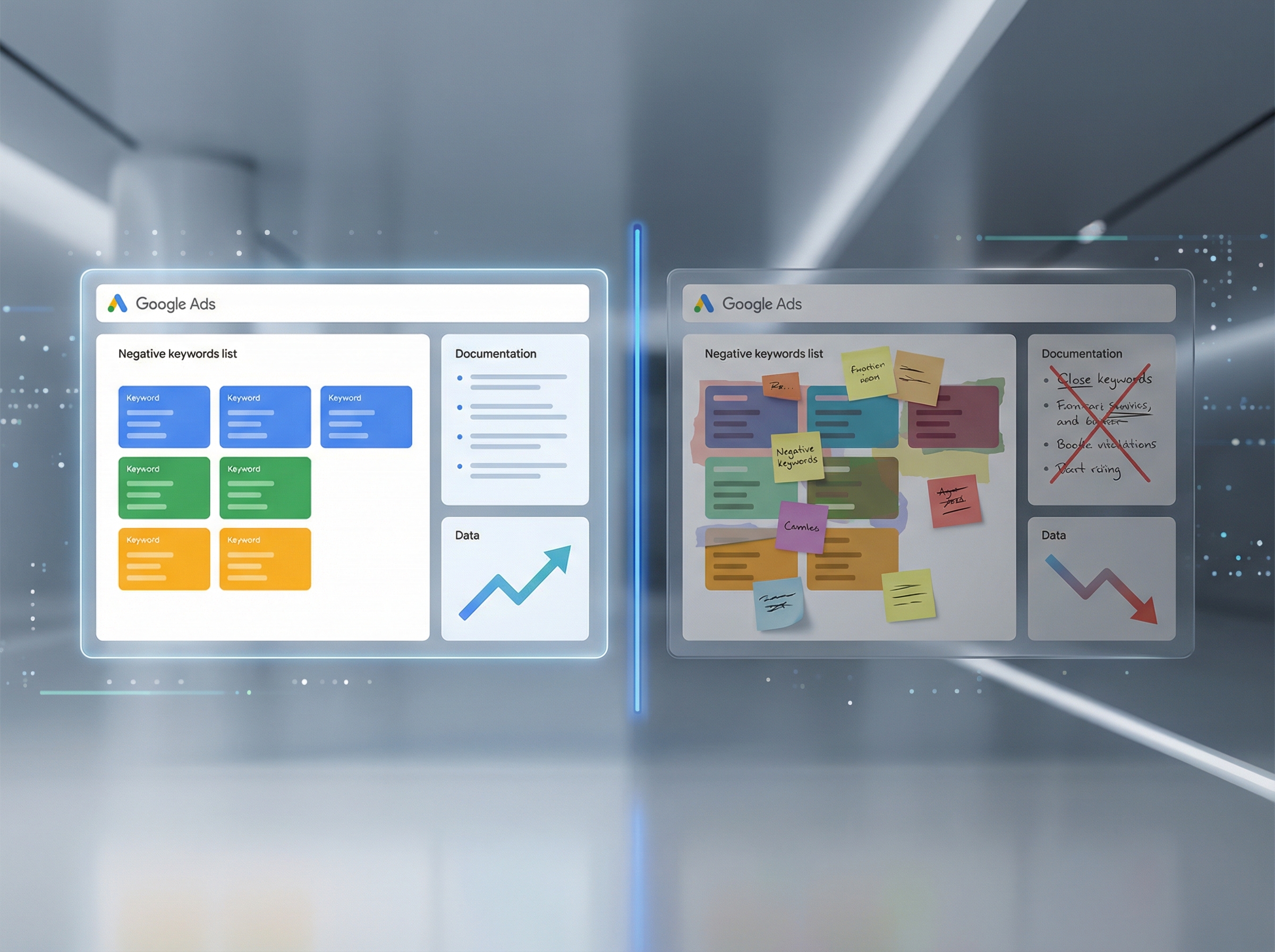
Technical debt, borrowed from software development, describes the implied cost of rework caused by choosing quick, easy solutions now instead of better approaches that take longer. In PPC, negative keyword technical debt manifests as the accumulated burden of shortcuts, inconsistent decisions, and undocumented exclusions that slow future optimization work.
It shows up as:
- Duplicate negative keywords scattered across campaign, ad group, and account levels with no clear hierarchy
- Conflicting exclusions where one campaign blocks terms another targets
- Undocumented negative keyword lists with names like "Old List 2" or "Test Exclusions"
- Hundreds of single-word broad match negatives added reactively without strategic context
- No record of why specific terms were excluded or when decisions were made
- Exclusion logic that made sense for last year's product mix but conflicts with current offerings
This debt compounds. Every reactive addition without documentation adds to the burden. Every team transition loses institutional knowledge. Every campaign restructure inherits contradictory logic. According to research on negative keyword implementation, poorly managed exclusion lists can result in wasted spend ranging from 10-20% of total budget, with strategic negative keyword management reducing wasted spend by up to 67%.
How Technical Debt Destroys Your Ability to Pivot Quickly
When you need to execute a strategic pivot—launching a new product line, exiting a service, adjusting positioning, or responding to competitive pressure—your negative keyword architecture either enables or prevents rapid execution.
Scenario One: Launching a New Product Category
Clean account with minimal technical debt: You review your master negative keyword documentation, identify three exclusion lists that conflict with the new category, remove the new product terms from those lists, and launch. Day one traffic is clean and relevant. Time to full deployment: two days.
Account with significant technical debt: You launch the new campaign, immediately see irrelevant traffic, realize unknown negative keyword lists are blocking valuable searches, spend a week identifying which of your 47 negative keyword lists apply to which campaigns, discover conflicting exclusions, rebuild lists from scratch, and finally achieve clean traffic. Time to full deployment: three weeks. Budget wasted on investigation and cleanup: $8,000.
Scenario Two: Discontinuing a Service Line
Clean account: You add the discontinued service terms to your universal negative keyword list, verify no active campaigns target those terms as positives, and pause relevant campaigns. Execution time: one day.
Account with technical debt: You add negatives, but your broad match keywords in other campaigns still trigger ads for the discontinued service. You discover overlap you did not document. You spend two weeks identifying every keyword that could match discontinued terms, restructuring ad groups to separate intent, and adding granular negatives. Wasted spend while correcting: $12,000.
Scenario Three: Repositioning from Budget to Premium
Clean account: Your negative keyword lists are segmented by customer intent. You have a documented "budget-seeker exclusions" list you can immediately activate across premium campaigns. You launch the repositioned messaging with pre-built exclusion architecture. Clean traffic from day one.
Account with debt: You have hundreds of individual negative keywords added reactively over three years. You have no idea which relate to budget-seekers versus other irrelevant intent. You launch the new positioning, see terrible traffic quality, and spend a month rebuilding exclusion logic while bleeding budget. Cost of delayed execution: $15,000 in wasted spend plus lost conversion opportunity during the messy transition period.
According to 2025 Google Ads benchmark data, the median time to campaign optimization varies dramatically by account maturity, with well-maintained accounts achieving target performance 3-4x faster than accounts requiring structural cleanup.
The Five Primary Sources of Negative Keyword Technical Debt
Source One: Reactive, Undocumented Additions
You check search terms on Friday afternoon, see five bad queries, add them as negatives without notes, and move on. Repeat this 200 times over two years. You now have 1,000 negative keywords with zero context about why they were added, what problem they solved, or whether they are still relevant.
This prevents informed decision-making during pivots. You cannot confidently remove outdated exclusions because you do not know their original purpose. You cannot identify patterns because additions were isolated reactions, not strategic decisions. Proper documentation standards solve this problem, but most accounts never implement them until it is too late.
Source Two: Team Turnover Without Knowledge Transfer
Your original PPC manager added 500 strategic negative keywords with clear logic. They left. The replacement inherited the account, saw the negatives, assumed they were correct, and added 300 more without understanding the existing architecture. Then that person left. Now you have 800 negatives with three different organizational philosophies and no documentation explaining any of them.
Research shows that 40% of exclusion intelligence is lost during team transitions when proper handoff protocols are not in place. This lost knowledge becomes debt that slows future optimization.
Source Three: Campaign Restructures That Orphan Negatives
You restructured campaigns six months ago, moving keywords between ad groups and consolidating campaigns. You forgot to audit which negative keywords should move with which positives. Now you have negative keywords at the ad group level blocking terms you actively target at the campaign level, or exclusions applied to the wrong campaigns entirely because they were attached to old structures that no longer exist.
This creates invisible conflicts that only surface during pivots, when you suddenly realize your exclusion architecture does not match your current campaign structure.
Source Four: Inconsistent Match Type Strategy
You have the same term added as broad match negative in one campaign, phrase match in another, and exact match in a third. You have no documented standard for when to use which match type. During a pivot, you cannot predict how changes will behave because your exclusion logic is inconsistent.
This inconsistency creates unpredictable behavior during launches, forcing extensive testing and cleanup that delays time-to-market.
Source Five: No Connection Between Exclusions and Business Context
Your negative keyword lists do not indicate why terms were excluded. Were they excluded because of low conversion rates? Poor product fit? Seasonal irrelevance? Legal restrictions? Without this context, you cannot make informed decisions when business conditions change.
Example: You excluded "cheap" as a broad match negative two years ago when positioning as premium. Now you are launching a budget product line. Should you remove "cheap" from negatives? You have no idea, because you have no record of the original strategic decision or whether it applied globally or to specific campaigns.
The Compound Interest Effect: How Small Debt Becomes Paralyzing
Technical debt does not accumulate linearly. It compounds. Each piece of undocumented debt makes future decisions harder, which encourages more shortcuts, which creates more debt.
The cycle looks like this:
- You make a reactive negative keyword addition without documentation because you are busy
- The lack of documentation makes it harder to understand your exclusion architecture
- The poor understanding makes you hesitant to restructure or optimize negatives strategically
- The lack of strategic management leads to more reactive additions
- Repeat until your account is paralyzed by conflicting, undocumented exclusions
According to campaign scalability research, negative keyword management complexity grows exponentially with account size, and without systematic approaches, accounts reach a point where optimization becomes effectively impossible without complete reconstruction.
The breaking point typically arrives when you attempt a major pivot and discover that your negative keyword architecture has become so convoluted that the only viable solution is to rebuild from scratch—a process that can take months and cost tens of thousands in consulting fees or internal labor.

How to Measure Your Current Negative Keyword Technical Debt
You cannot fix what you cannot measure. Use these diagnostic questions to assess your account's debt load:
Documentation Quality Audit
- Can you explain why each negative keyword list exists and what problem it solves?
- Do your negative keyword list names clearly indicate their purpose and scope?
- Do you have a written record of when major exclusion decisions were made and by whom?
- Could a new team member understand your exclusion strategy from documentation alone?
If you answered no to more than two questions, your documentation debt is significant and will slow pivots.
Structural Consistency Audit
- Do you have duplicate negative keywords at different campaign levels?
- Have you restructured campaigns without updating negative keyword placement?
- Do you have negatives added at ad group level that conflict with campaign-level targeting?
- Can you describe your negative keyword hierarchy in one clear sentence?
If you have duplicates, orphaned negatives, or cannot articulate hierarchy, your structural debt is slowing optimization.
Business Context Alignment Audit
- Do your exclusions reflect current product offerings and positioning?
- Can you identify which negatives relate to discontinued products or old strategies?
- Do you know which exclusions are seasonal versus permanent?
- Have you audited negative keywords for relevance in the past six months?
If your exclusions do not align with current business reality, your strategic debt will prevent effective pivots. A comprehensive assessment framework can help quantify this misalignment.
The Real Business Cost of Slow Pivot Speed
Technical debt is not an abstract concept. It has measurable business impact.
Delayed Product Launches
When launching a new product requires three weeks of negative keyword cleanup instead of three days, you lose 18 days of market opportunity. If that product generates $500 per day in profit, delayed launch costs $9,000 in lost revenue plus the wasted ad spend during the messy launch period.
Slow Competitive Response
Your competitor launches an aggressive campaign targeting your brand terms. Clean accounts can respond same-day with defensive campaigns and appropriate exclusions. Accounts with technical debt take a week to configure proper negative keyword coverage, losing a week of defensive positioning.
Seasonal Opportunity Windows
You have a two-week window for Q4 promotional campaigns. Clean accounts configure seasonal exclusions in one day and maximize the window. Debt-heavy accounts spend the first week cleaning up conflicts and only capture half the opportunity.
Ongoing Budget Waste From Inaction
The biggest cost is often the optimization you avoid because technical debt makes it too complex. You know your negative keywords need restructuring, but the scope is overwhelming, so you do nothing. Meanwhile, you waste 15% of your budget monthly on traffic that proper exclusions would prevent. For a $50,000 monthly budget, that is $7,500 per month in preventable waste, or $90,000 annually.
Across all impacts, significant negative keyword technical debt typically costs accounts between 12-25% of annual ad spend in direct waste plus opportunity cost from delayed or abandoned optimizations.
How Competitors With Fast Pivot Speed Maintain Low Technical Debt
Accounts that pivot quickly do not avoid technical debt through luck. They follow specific practices that prevent debt accumulation.
Practice One: Documentation Standards From Day One
Every negative keyword addition includes a note explaining why it was added, what problem it solved, and whether it is permanent or temporary. Negative keyword lists have clear naming conventions that indicate purpose and scope. Examples: "Brand-Protection-Competitors" or "Seasonal-Winter-2024-Holiday-Exclusions" instead of "List 3" or "New Negatives."
Practice Two: Clear Hierarchical Structure
These accounts define and document a clear hierarchy: account-level negatives for universal exclusions, campaign-level for category-specific exclusions, ad-group-level only for highly granular exceptions. This structure is documented and enforced, preventing the chaos of scattered, duplicative negatives.
Practice Three: Quarterly Negative Keyword Audits
Every quarter, these accounts review all negative keywords against current business reality. They remove outdated exclusions, consolidate duplicates, update documentation, and verify alignment with current offerings. This prevents drift between exclusion logic and business strategy. According to account hygiene best practices, regular audits are the single most effective debt prevention measure.
Practice Four: Negative Keyword Change Logs
These accounts maintain a simple log tracking major negative keyword decisions: what changed, when, why, and who approved it. This creates institutional memory that survives team transitions and enables informed future decisions.
Practice Five: AI-Powered Automation With Human Context
Rather than manually reviewing thousands of search terms, leading accounts use AI-powered tools that classify search terms based on business context and existing keyword strategy. This prevents the reactive, undocumented additions that create debt while maintaining the human oversight necessary for strategic alignment. Negator.io, for example, analyzes search terms using contextual understanding of your business and keywords, suggesting exclusions that align with your strategy rather than applying generic rules.
The Debt Reduction Roadmap: From Paralyzed to Pivot-Ready
If your account already carries significant negative keyword technical debt, you can systematically reduce it without starting from scratch.
Phase One: Stop Accumulating New Debt (Week 1)
Before fixing existing debt, stop creating new debt. Implement these immediate changes:
- Require documentation for every new negative keyword addition—even a brief note explaining why
- Establish naming conventions for new negative keyword lists
- Define and document your negative keyword hierarchy standard
- Create a change log template for tracking major decisions going forward
Phase Two: Document Current State (Weeks 2-3)
Export all negative keywords. Create a spreadsheet documenting:
- Every negative keyword list name and location (account, campaign, or ad group level)
- Number of terms in each list
- Campaign or ad group associations
- Best guess at purpose based on term content
- Obvious duplicates or conflicts
This audit creates visibility. You cannot fix what you cannot see.
Phase Three: Consolidate Obvious Duplicates (Week 4)
Identify negative keywords appearing at multiple levels or in multiple lists without strategic reason. Consolidate them into appropriately-named lists at the correct hierarchical level. This immediately reduces complexity and prevents conflicting logic.
Phase Four: Align With Current Business Reality (Weeks 5-6)
Review all negative keywords against your current product catalog, positioning, and strategy:
- Remove exclusions for discontinued products you no longer need to block
- Remove exclusions that conflict with current offerings
- Add missing exclusions for newly-introduced products or positioning
- Update list names to reflect current purpose
Phase Five: Establish Ongoing Maintenance (Week 7 and Beyond)
Schedule quarterly negative keyword audits. Assign responsibility. Create checklist protocols. Implement AI-powered assistance to reduce manual burden while maintaining strategic oversight.
The result: An account that pivots in days instead of weeks, responds to market changes immediately instead of reactively, and maintains clean traffic without constant firefighting.
Pivot Speed as Sustainable Competitive Advantage
In markets where every competitor has access to the same ad platform, similar budgets, and comparable tools, competitive advantage comes from execution speed. The accounts that win are not those with the biggest budgets or the most sophisticated strategies—they are the accounts that can execute strategy changes cleanly and quickly when market conditions demand it.
Negative keyword technical debt is the invisible anchor slowing your pivots, delaying your launches, and costing you tens of thousands in wasted spend and lost opportunities. Your competitors who pivot faster are not smarter or better-funded. They simply maintain cleaner negative keyword architectures that enable rapid strategic shifts without weeks of cleanup work.
You have a choice: Continue accumulating debt through reactive, undocumented negative keyword management and accept that every future pivot will take weeks of painful cleanup, or invest in systematic debt reduction and prevention that transforms your account into a competitive weapon capable of executing strategic changes in days.
The market does not wait for accounts burdened by technical debt to catch up. Start reducing your negative keyword technical debt today, and reclaim the pivot speed that separates market leaders from perpetual followers.
Why Your Google Ads Account Recovers Slower Than Competitors: The Negative Keyword Technical Debt Slowing Your Pivot Speed
Discover more about high-performance web design. Follow us on Twitter and Instagram

.webp)




Fresh trends & insights

[ Follow us ]
[ Join our newsletter ]